
Collagen Stimulators in Singapore
Injectable Collagen Stimulation & Skin Rejuvenation
Restore Skin Structure by Stimulating Your Own Collagen
Stimulate Collagen. Support Healthy Skin.
As we age, our skin gradually loses collagen, leading to reduced skin firmness, facial volume loss and the development of fine lines and wrinkles. Collagen stimulators work by encouraging your body's natural collagen production, helping to gradually improve skin quality, facial support and overall skin rejuvenation.
At Emberwood Aesthetics, every treatment plan is personalised according to your facial anatomy, skin quality and ageing concerns to achieve balanced, natural-looking results.
What Are Collagen stimulators?
Collagen stimulators are injectable treatments that work by stimulating the body's own collagen production. Unlike traditional fillers, which primarily restore lost volume, collagen biostimulators encourage gradual tissue remodelling, leading to improvements in skin firmness, elasticity and structural support over time.
This regenerative approach makes them particularly suitable for patients seeking subtle, long-term improvements rather than immediate volumisation. As collagen rebuilds, patients may notice improvements in skin firmness, elasticity, facial support and overall skin quality. Because results develop progressively, the outcome is often subtle and natural-looking.
What Happens to Our Skin as We Age?
One of the key reasons our skin changes with age is the gradual decline in collagen production. Collagen is one of the skin's most important structural proteins, providing strength, firmness, and support. As we age, the body's natural collagen production gradually declines, reducing the skin's ability to maintain its youthful structure and elasticity.
However, facial ageing is not caused by collagen loss alone. Several changes occur simultaneously, including:
Reduced collagen and elastin, leading to decreased skin firmness and elasticity.
Changes in facial fat compartments, contributing to loss of facial volume and definition.
Bone remodelling, which gradually alters the structural support of the face.
Thinning of the skin, making fine lines, wrinkles and skin laxity more noticeable.
Together, these changes contribute to many of the visible signs of facial ageing, including skin laxity, wrinkles, loss of facial volume and reduced jawline definition. Collagen stimulators are designed to address one important aspect of this ageing process by encouraging the body's natural collagen production. As new collagen forms over time, the skin may gradually become firmer, more resilient and better supported, contributing to natural-looking skin rejuvenation.
How Do Collagen stimulators Work?
Initial Treatment
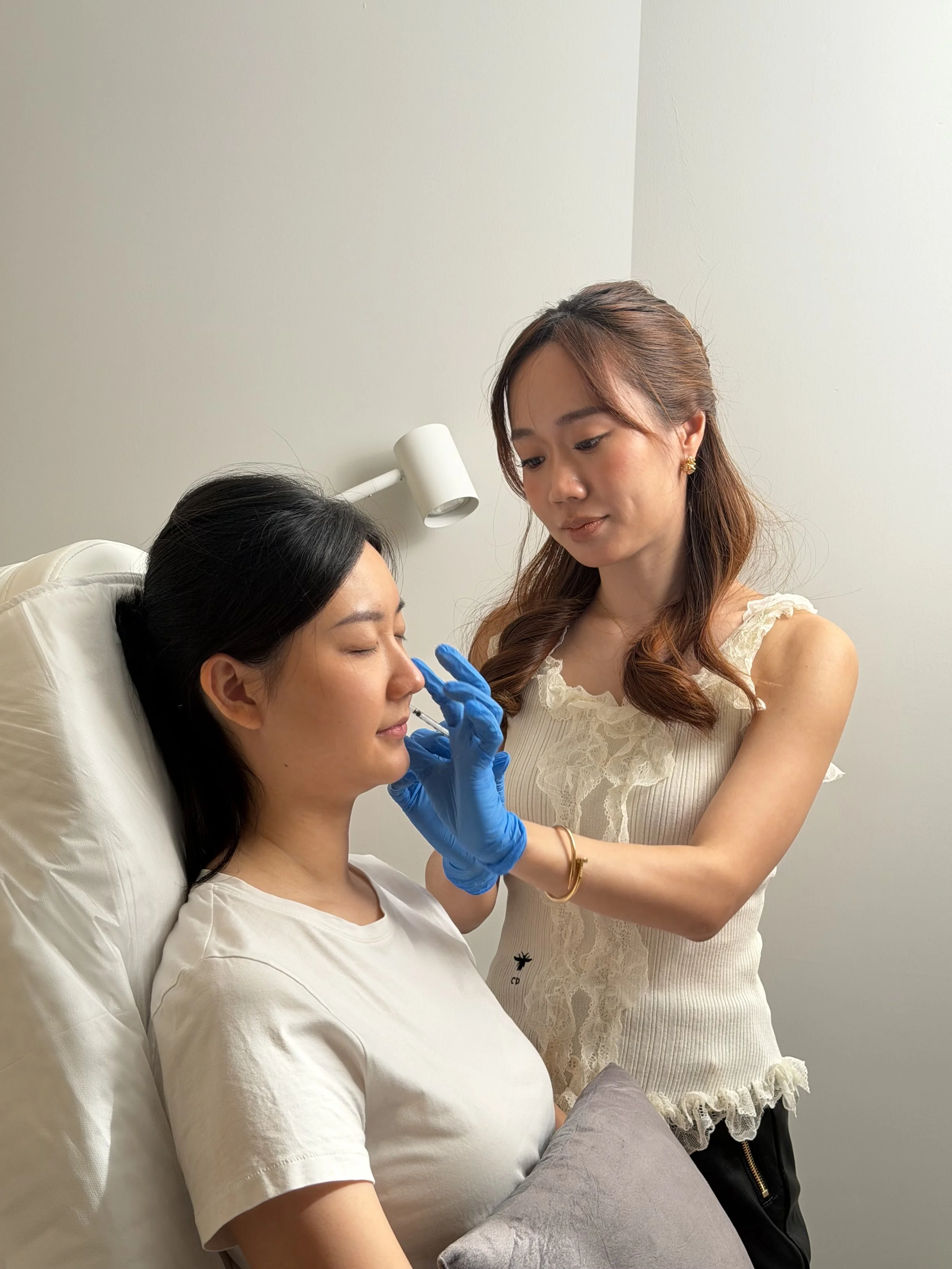
Collagen stimulators are carefully injected into selected treatment areas beneath the skin. Depending on the product used, some formulations may provide temporary volume immediately after treatment, while the primary effect develops gradually as the skin's natural collagen production is stimulated
Collagen Activation
Following treatment, the biostimulator encourages the body's natural healing response. Fibroblasts are stimulated to produce new collagen over the following weeks and months, supporting gradual collagen remodelling within the treated areas.Progressive Skin Remodelling
As collagen develops, patients may notice firmer, denser skin with gradual improvements in texture, elasticity and overall skin quality.
Progressive Skin Remodelling
As new collagen forms, patients may gradually notice improvements in skin firmness, elasticity and overall skin quality. Depending on the treatment goals and product used, collagen remodelling may also help improve facial support and soften selected signs of facial ageing over time.
Our Curated Approach to Collagen Stimulators
Collagen stimulators encompass several categories of injectable treatments, each developed with different properties and clinical applications. Some are designed primarily to support structural collagen remodelling, while others combine collagen stimulation with additional benefits such as immediate structural support. Rather than offering every treatment available on the market, Dr Jolenda carefully evaluates clinical evidence, treatment experience, and patient outcomes before incorporating new technologies into clinical practice. The range of collagen biostimulators available at Emberwood Aesthetics is therefore intentionally curated and evolves as newer evidence and technologies become available. Our focus is not on recommending a particular product, but on selecting the most appropriate treatment approach for each individual patient. If you are considering collagen biostimulator treatment, we invite you to book a consultation with Dr Jolenda. Following a comprehensive assessment of your skin quality, facial anatomy, and treatment goals, she will discuss the available treatment options and recommend a personalised approach that is most appropriate for you.
Types of Collagen Biostimulators
Calcium Hydroxylapatite (CaHA) Biostimulators
Calcium hydroxylapatite (CaHA) biostimulators are a category of injectable treatments designed to provide structural support while supporting the skin's natural collagen-producing processes over time. They combine an immediate structural component with gradual collagen remodelling, making them a commonly used option in regenerative aesthetic treatments.
HACa Hybrid Biostimulators
Hybrid HACa biostimulators are a category of injectable treatments that combine hyaluronic acid (HA) and calcium hydroxylapatite (CaHA) within a single formulation. By bringing together the characteristics of both materials, they are designed to provide structural support while supporting the skin's natural collagen-producing processes over time, offering a complementary approach to facial rejuvenation.
Injectable Collagen: A Different Approach to Collagen Treatment
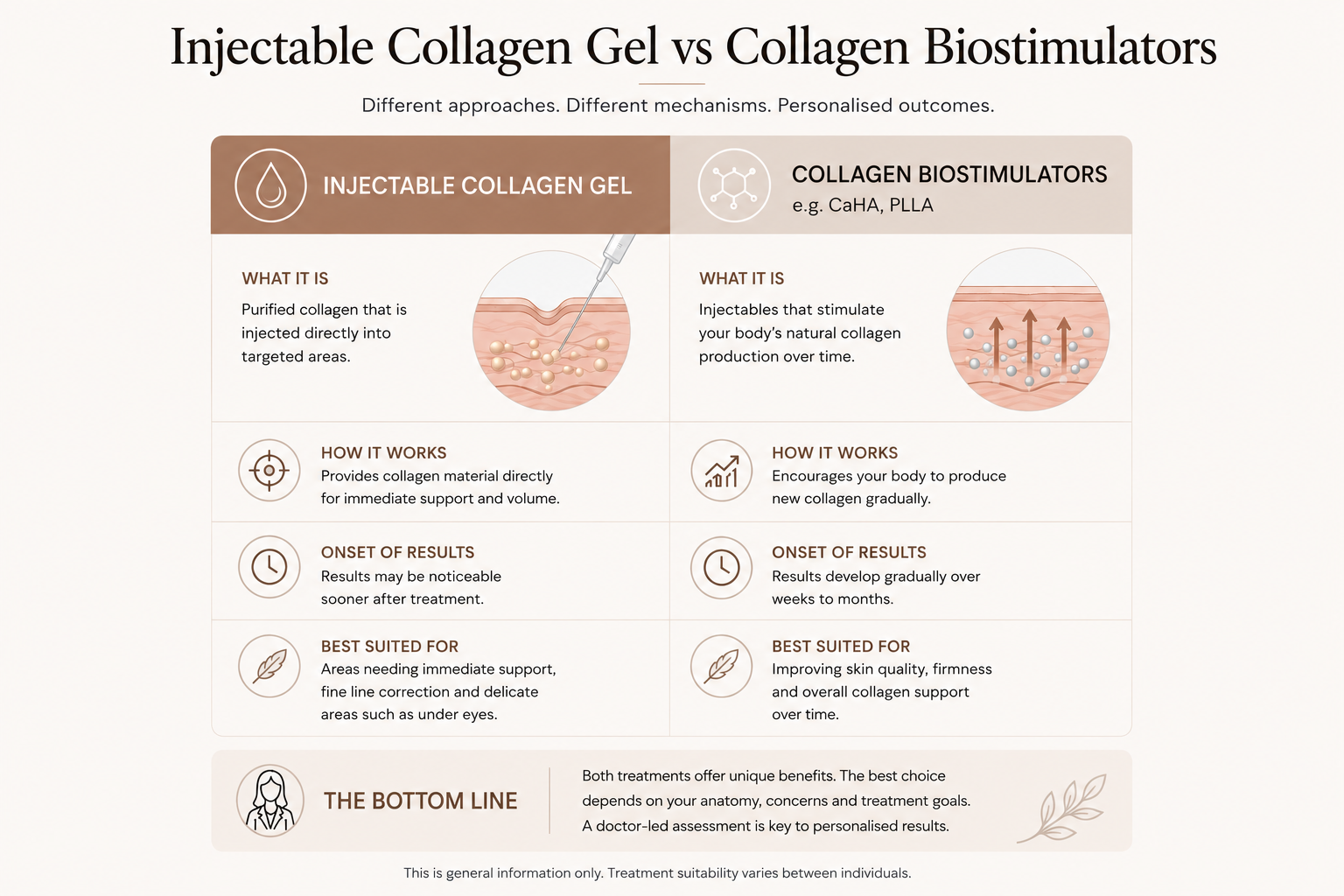
Not all collagen-focused injectable treatments work by stimulating the body to produce new collagen. Injectable collagen gel provides purified collagen directly within selected treatment areas, offering a different approach from collagen biostimulators such as CaHA-based treatments.
Injectable collagen may be considered for selected concerns including under-eye hollowing, tear troughs, and under-eye reduced tissue support. Treatment suitability depends on the area being treated, the underlying concern and the patient’s individual anatomy.
At Emberwood Aesthetics, your doctor will assess whether injectable collagen, a collagen stimulator, or another treatment approach may be more appropriate for your concerns.
Frequently Asked Questions about collagen biostimulators
-
Collagen biostimulators are injectable treatments designed to support the skin's natural collagen-producing processes. Rather than primarily restoring volume, these treatments are intended to encourage gradual improvements in skin firmness, elasticity and overall skin quality over time.
Different collagen biostimulators have different properties and clinical applications. Your doctor will recommend a treatment based on your individual skin concerns, anatomy and treatment goals.
-
Getting started is simple. Reach out through our contact form or contact us via WhatsApp - we ’ll walk you through the next steps on setting up an appointment with our doctor for consultation.
-
Although both are injectable treatments, they are designed with different treatment objectives.
Dermal fillers are generally used to restore volume, enhance facial contours or soften selected lines and folds. Collagen biostimulators are intended to support gradual improvements in skin quality and structural support through collagen remodelling.
Depending on your clinical assessment, your doctor may recommend one treatment or a combination of different injectable treatments.
-
Both collagen biostimulators and skin boosters are used to improve skin quality, but they do so through different mechanisms and treatment approaches.
Skin boosters are generally used to improve hydration and overall skin quality, while collagen biostimulators are intended to support longer-term collagen remodelling and structural improvement.
The most appropriate treatment depends on your skin concerns, treatment goals, and your doctor's assessment.
-
In appropriate patients, collagen biostimulators may be incorporated into a broader treatment plan alongside other injectable or energy-based treatments.
Whether combination treatment is appropriate depends on your skin concerns, treatment goals, and your doctor's assessment.
-
No. As with any medical treatment, collagen biostimulators may not be suitable for every individual.
Your doctor will review your medical history, examine your skin and discuss your treatment goals before advising whether collagen biostimulators are appropriate for you.