Acne Scar Treatment in Singapore
Acne scars are a common consequence of moderate to severe acne and can affect skin texture long after active breakouts have settled. At Emberwood Aesthetics, Dr Jolenda develops personalised acne scar treatment plans based on the type of scars present, your skin type, and your treatment goals. Treatment may involve a combination of subcision, RF microneedling, TCA CROSS, regenerative injectables, laser resurfacing and other procedures to improve skin texture through collagen remodelling.
What Are Acne Scars?
Acne scars are more than just marks left behind after breakouts, they are permanent structural changes within the skin. When acne inflammation extends deep into the skin, it damages collagen, fat and supporting tissue beneath the surface. As the skin heals, collagen may not regenerate evenly, leading to depressed scars, uneven texture and visible skin irregularities.Why Do Acne Scars Form?
Acne scars form when inflammation from acne damages the skin's deeper layers, triggering the breakdown of collagen, the protein that provides the skin with structure and support. As the skin enters the healing phase, it attempts to repair the damage by producing new collagen. However, if there is insufficient collagen production, tissue loss occurs, leaving behind depressed scars. In some cases, fibrous scar bands develop beneath the skin during healing, causing tethering that pulls the skin downward and creates rolling scars. The greater the inflammation and collagen damage, the higher the risk of permanent acne scarring.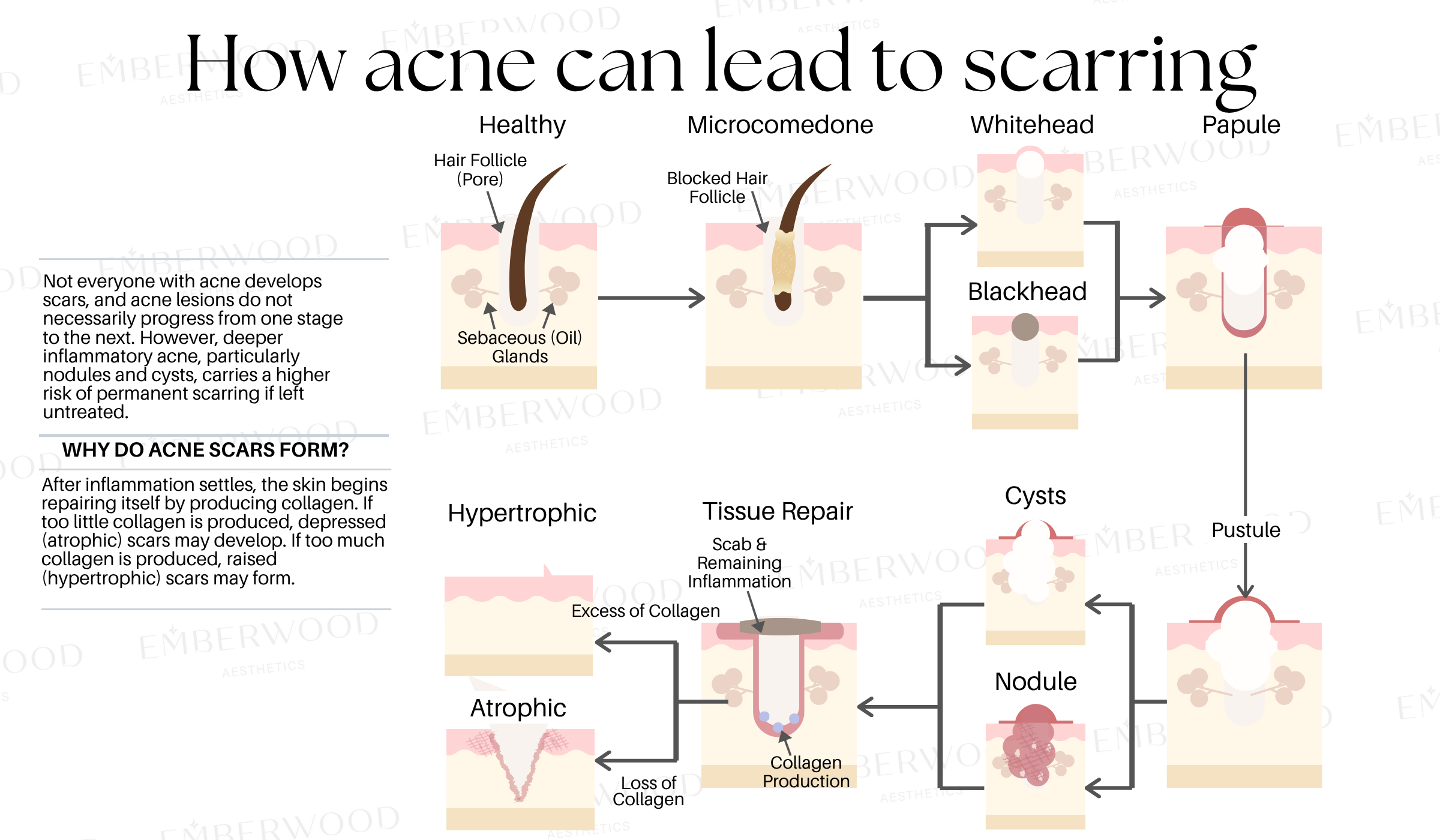
Types of Acne Scars
Hypertrophic Scars
Hypertrophic acne scars are raised, thickened scars caused by excessive collagen production during wound healing. Unlike atrophic acne scars, which appear as depressions in the skin, hypertrophic scars project above the skin surface while remaining confined to the original area of injury. Atrophic Scars
Rolling Acne Scars
Rolling acne scars appear as broad depressions with gently sloping edges, giving the skin an uneven or wave-like appearance. They are caused by fibrous scar bands that tether the skin to the underlying tissues beneath the surface. Because the underlying scar bands are responsible for the depression, treatments such as subcision are often considered to release these attachments before collagen-stimulating procedures are performed.Boxcar Acne Scars
Boxcar acne scars are broad, shallow-to-deep depressions with well-defined edges that give the skin a pitted appearance. They develop when inflammation damages collagen and supporting tissues within the deeper layers of the skin, resulting in permanent tissue loss after healing. Unlike rolling scars, boxcar scars are not typically tethered by fibrous scar bands, so treatments often focus on stimulating collagen remodelling and improving skin texture. Ice Pick Acne Scars
Ice pick acne scars are narrow, deep scars that extend vertically into the skin, giving the appearance of small puncture wounds. They are among the deepest types of atrophic acne scars and develop when severe inflammation destroys collagen within a small area of skin. Because these scars extend deeply beneath the surface, they are often more challenging to treat than rolling or boxcar scars. 
Post-Inflammatory Hyperpigmentation & Erythema
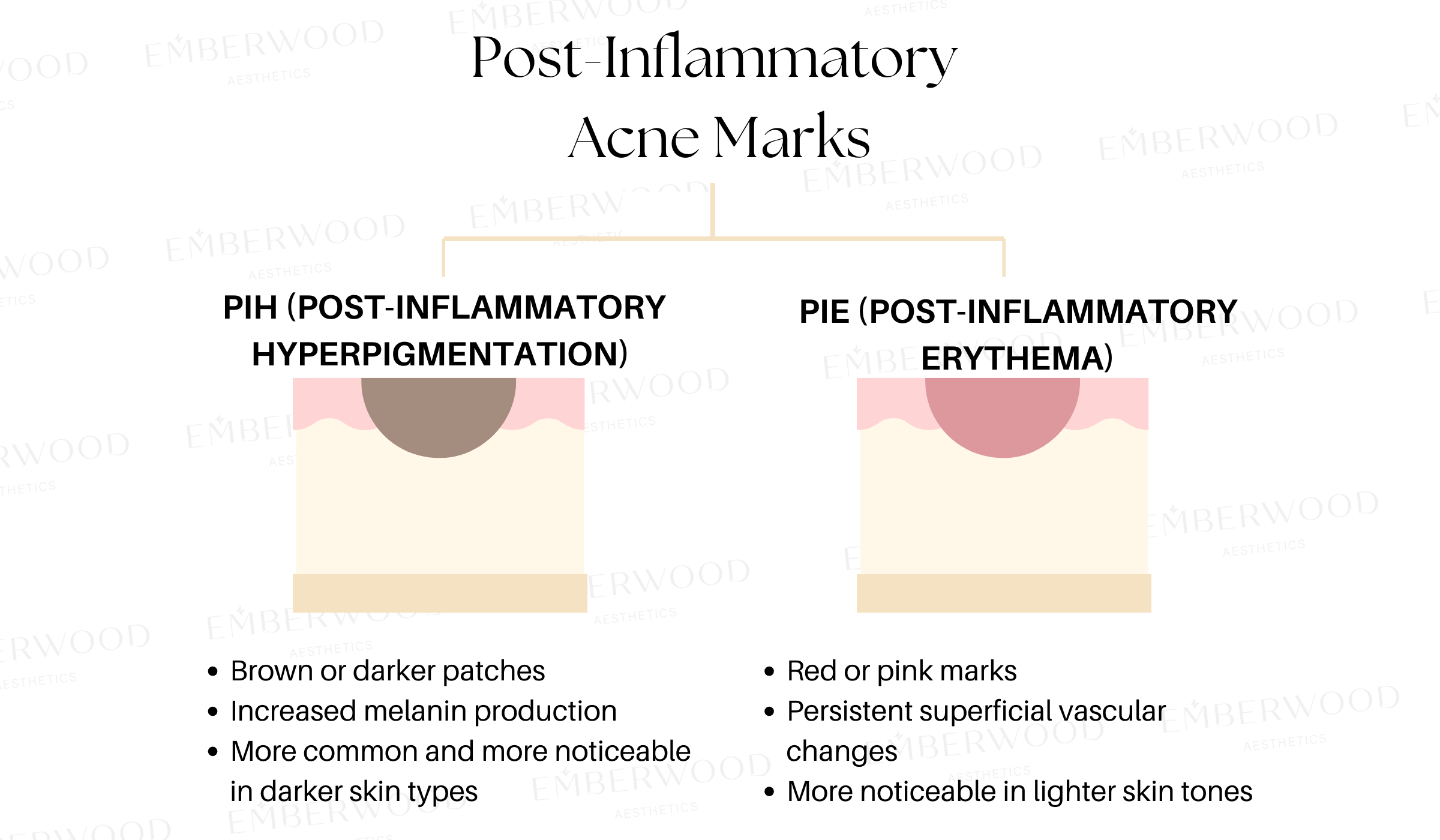
Red, pink, or brown marks left behind after acne are often mistaken for acne scars, but they are not true scars because they do not involve permanent structural damage to the skin. Instead, they represent temporary changes in the skin's blood vessels or pigmentation following inflammation.
Post-inflammatory erythema (PIE) appears as persistent red or pink marks caused by dilated superficial blood vessels after inflammation has resolved. It is generally more noticeable in individuals with lighter skin tones. Post-inflammatory hyperpigmentation (PIH) appears as brown or darker patches caused by increased melanin production during the healing process. It is generally more common and more noticeable in individuals with darker skin types. Unlike true acne scars, PIE and PIH usually improve gradually over time, although the rate of improvement varies between individuals. Appropriate skincare and medical treatments may help accelerate their resolution.
How Are Acne Scars Treated?
Because different acne scars have different underlying causes, there is rarely a single treatment that is suitable for every patient. The most appropriate treatment depends on the type of acne scars present, their severity, your skin type, and your treatment goals. Rather than relying on a single procedure, treatment often involves a personalised combination of techniques that target different aspects of acne scarring, including fibrous tethering, collagen loss, tissue atrophy, and surface irregularities.-
Subcision is a minimally invasive procedure used to treat rolling acne scars by releasing the fibrous scar bands that tether the skin to the underlying tissue. A fine needle or a blunt-tipped cannula is inserted beneath the scar to carefully break these bands, allowing the depressed skin to lift and creating space for new collagen to form during healing. Needle subcision offers precise treatment for individual scars, while cannula subcision can treat a larger area through fewer entry points and may reduce bruising and the risk of injury to surrounding structures. Subcision is often combined with treatments such as PDRN skinboosters, laser resurfacing, or radiofrequency microneedling to further improve skin texture and achieve optimal results.
-
PDRN skinboosters are regenerative injectables that support the skin's natural healing process and stimulate tissue repair, making them a valuable adjunct in the treatment of acne scars. By promoting collagen production, improving skin quality, and reducing inflammation, PDRN helps enhance skin texture and supports recovery following procedures such as subcision, laser resurfacing, and radiofrequency microneedling. Newer formulations combine PDRN with lidocaine and hyaluronic acid (HA), making the treatment significantly more comfortable while also providing deep hydration. The addition of lidocaine reduces injection discomfort, while hyaluronic acid improves skin hydration, elasticity, and overall skin quality, complementing the regenerative effects of PDRN. Together with subcision, PDRN can accelerate healing, improve collagen remodelling, and optimise results when incorporated into a comprehensive acne scar treatment plan
-
TCA CROSS (Trichloroacetic Acid Chemical Reconstruction of Skin Scars) is a highly targeted treatment designed for ice pick scars and selected narrow boxcar scars. A high concentration of trichloroacetic acid is carefully applied into the base of each scar, creating a controlled chemical injury that stimulates collagen remodelling and gradually elevates the depressed scar over a series of treatments. Because the acid is applied only within the scar, the surrounding skin is largely unaffected. Following treatment, the treated spots typically turn white (frosting), then develop small brown scabs that naturally shed within 5–7 days. Mild redness may persist for 1–2 weeks, particularly in individuals with sensitive skin, while the risk of temporary post-inflammatory hyperpigmentation is higher in darker skin types. Multiple sessions spaced 6–8 weeks apart are usually required for optimal improvement, and TCA CROSS is often combined with subcision, laser resurfacing, or radiofrequency microneedling to address different types of acne scars comprehensively.
-
Radiofrequency (RF) Microneedling is an effective treatment for atrophic acne scars, particularly rolling and boxcar scars. The treatment uses fine insulated needles to create controlled micro-injuries while delivering radiofrequency energy into the deeper layers of the skin. This stimulates collagen and elastin production, remodels scar tissue, and improves skin texture with minimal damage to the skin surface. Compared to conventional microneedling, the addition of radiofrequency allows for deeper, more targeted collagen remodelling and can provide greater improvement in acne scars with less downtime. Patients can expect mild redness and swelling for 1–3 days, with occasional pinpoint scabbing or a sandpaper-like skin texture that typically resolves within 3–7 days. A series of 3–5 treatments, spaced 4–8 weeks apart, is usually recommended for optimal results. RF microneedling is often combined with treatments such as subcision, TCA CROSS, PDRN skinboosters, or laser resurfacing as part of a comprehensive acne scar treatment plan.
-
755 nm Alexandrite Picosecond Laser with Titanium Fractional Focus Lens is an advanced laser treatment that improves atrophic acne scars by creating microscopic zones of laser-induced injury within the skin while leaving the surrounding tissue intact. Using a specialised fractional focus lens, the laser concentrates energy into tiny focal points beneath the skin, producing laser-induced optical breakdown (LIOB). This stimulates collagen remodelling and new collagen formation without significant thermal damage, helping to soften and improve the appearance of rolling, boxcar, and superficial acne scars. In addition to scar remodelling, the 755 nm wavelength can also improve post-inflammatory hyperpigmentation and overall skin tone, making it particularly beneficial for patients with both acne scars and residual acne marks. Downtime is typically minimal, with mild redness and swelling lasting 1–2 days. A series of 3–5 treatment sessions, spaced 4–8 weeks apart, is usually recommended for optimal results, and the treatment is often combined with subcision, TCA CROSS, RF microneedling, or regenerative injectables as part of a comprehensive acne scar management plan.
-
Dermal Fillers can be used to improve selected atrophic acne scars, particularly rolling scars and deeper depressed scars caused by volume loss. Hyaluronic acid fillers are carefully injected beneath the scar to immediately lift the depressed area and restore a smoother skin surface. In addition to providing instant improvement, the injection process may also stimulate collagen production over time. Dermal fillers are often used after subcision, once the fibrous scar bands have been released, to prevent the skin from reattaching and to maintain elevation of the scar. Results are visible immediately, with minimal downtime aside from mild swelling or bruising that typically resolves within a few days.
Why Combination Acne Scar Treatment Often Produces Better Results?
Acne scars are rarely all the same. Most patients have a combination of rolling, boxcar, and ice pick scars, with each type arising from a different underlying problem, such as fibrous tethering, collagen loss, tissue atrophy, or surface irregularities. No single treatment can effectively address all of these factors. For example, subcision releases tethered rolling scars, TCA CROSS targets deep ice pick scars, RF microneedling and fractional 755 nm picosecond laser resurfacing stimulate collagen remodelling and improve skin texture, while PDRN skinboosters and dermal fillers enhance tissue repair and restore volume where needed. By combining treatments that target different aspects of scar formation, a synergistic effect is achieved, each treatment complements the others, leading to greater collagen regeneration, more comprehensive scar improvement, and better overall skin texture than any single treatment alone. A personalised combination treatment plan is therefore often the most effective approach to achieving natural, long-lasting results.What Results Can You Expect?
Acne scar treatment is a gradual process that relies on collagen remodelling, which continues for several months after each session. Most patients require multiple treatment sessions, as collagen regeneration takes time and different scar types often need different treatment modalities. While significant improvements in skin texture and scar depth are achievable, complete scar removal is not possible, and maintaining realistic expectations is important. Every treatment plan is personalised based on the type, severity, and extent of scarring, skin type, and individual healing response, with the goal of achieving the greatest possible improvement while maintaining natural-looking results.Personalised Acne Scar Treatment
At Emberwood Aesthetics, Dr Jolenda tailors acne scar treatment according to scar morphology, skin quality, active acne, downtime preferences, and individual healing response. Rather than relying on a single procedure, treatment plans are personalised to address the different components of acne scarring. Every patient's skin is different, and the first step towards improving acne scars is an accurate assessment. Schedule a consultation to discuss your concerns and receive a personalised treatment recommendation.Frequently Asked Questions about Acne Scars and Acne Scar Treatments in Singapore
-
No. While acne scars cannot be removed completely, modern treatments can significantly improve their appearance, making scars much less noticeable and improving overall skin texture.
-
There is no single "best" treatment, as the ideal approach depends on the type and severity of your scars. Most patients achieve the best results with a personalised combination of treatments such as subcision, TCA CROSS, RF microneedling, laser resurfacing, and regenerative injectables.
-
Most patients require 3–6 treatment sessions, although more severe scarring may require additional treatments. Your treatment plan will be tailored based on your scar type, treatment goals, and response to therapy.
-
Yes, acne scars are considered permanent because they result from structural changes in the skin. However, they can often be significantly improved with appropriate treatment.
-
Laser treatments cannot completely remove acne scars, but they can stimulate collagen production, remodel scar tissue, and improve the appearance of many atrophic acne scars over time.
-
Neither treatment is better, they serve different purposes. Subcision is most effective for releasing tethered rolling scars, while laser resurfacing improves collagen remodelling and skin texture, which is why they are often combined.
-
Yes, regenerative skin boosters such as PDRN can support collagen remodelling, improve skin quality, and enhance healing after acne scar procedures. They are most effective when used as part of a comprehensive treatment plan rather than as a standalone treatment.
-
Most treatment plans are completed over 3–6 months, with sessions typically spaced 4–8 weeks apart to allow time for collagen remodelling and healing between treatments.
Contact Us
Your journey toward refined beauty starts with a conversation.
Share your aspirations with us, and our specialists will reach out to curate your personal consultation