

Botulinum Toxin Treatment in Singapore
Expression softened. Character preserved.
Botulinum toxin is often associated with forehead lines, but its uses extend well beyond the upper face. In carefully selected patients, it can be used to soften expression lines, refine a strong masseter or jawline, reduce a bulky trapezius or muscular calf contour, manage excessive sweating, and make subtle adjustments around the eyes, mouth, lower face and neck.
At Emberwood Aesthetics, every treatment begins with a doctor’s assessment. Rather than following a standard injection map, Dr Jolenda considers how your face moves, the relative strength of different muscles, your natural asymmetries and how much expression you would like to retain. The aim is not to erase movement, it is to create a result that still looks like you.
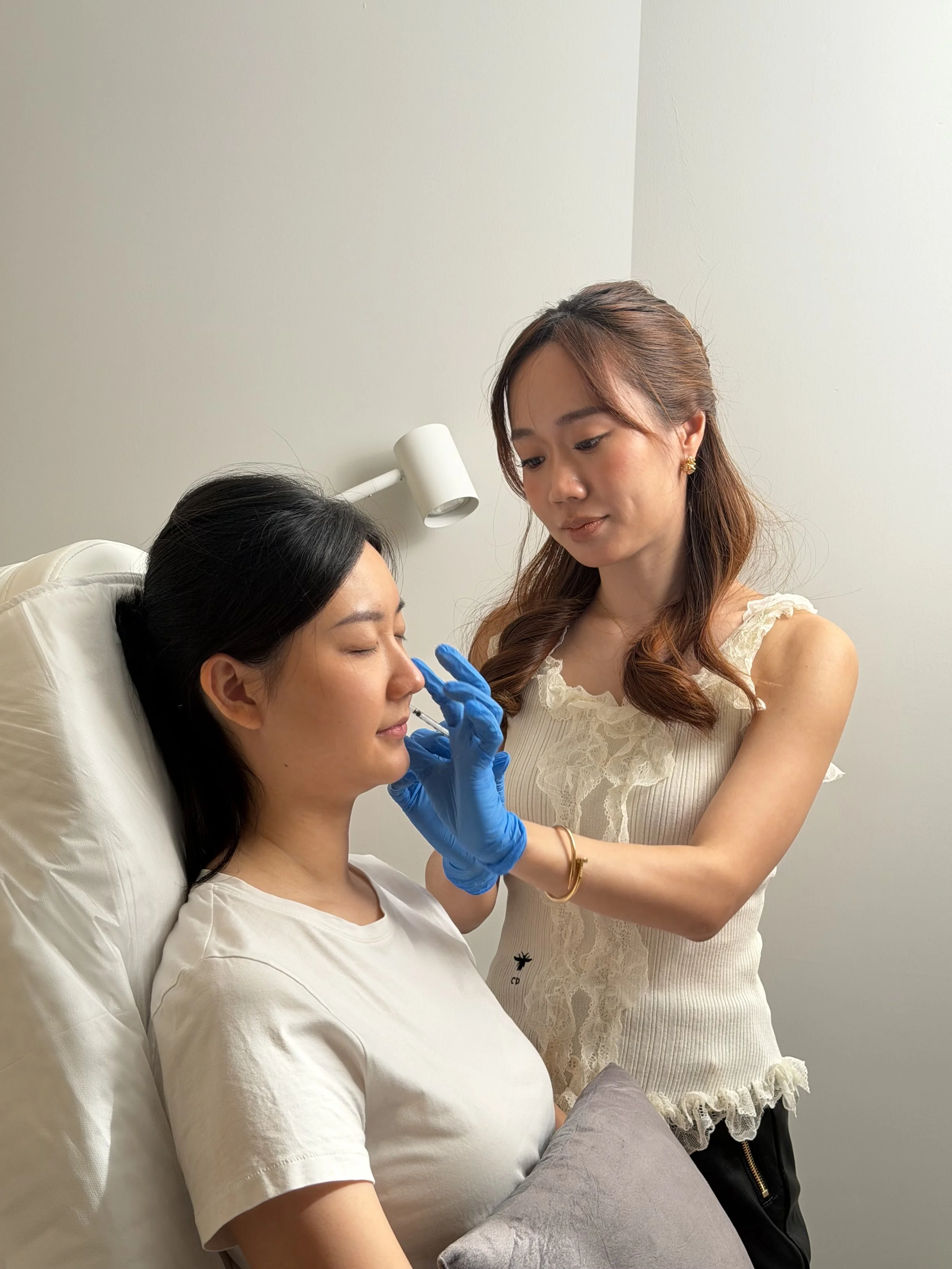
What is botulinum toxin, and how does it work?
Botulinum toxin is temporarily reduces the release of acetylcholine, the chemical signal that tells a muscle or sweat gland to activate.
Where it is placed determines what it does:
In selected facial muscles, it can soften lines caused by repeated expression.
In larger muscles such as the masseter, trapezius or calf, it can gradually reduce excessive muscle bulk and alter contour.
In the superficial skin layer, it may reduce sweat and oil activity and soften very fine lines.
Around the lower face and neck, careful treatment of downward-pulling muscles may create a subtle lifting or balancing effect.
The effect is temporary and develops gradually. The dose, depth and placement must be adapted to the treatment area and the individual, not simply copied from one person to another.
Which areas can botulinum toxin treat?
-
Yes. The upper face is treated by balancing the muscles that raise and lower the brows, rather than simply trying to stop all movement.
Common areas include:
Forehead lines
Frown lines between the eyebrows
Crow’s feet beside the eyes
Bunny lines at the sides of the nose
A subtle brow-opening effect in suitable patients
Some people prefer very soft movement, while others want stronger line reduction. Your plan can be adjusted to your expression pattern and preferences. Lines that are present only during movement generally respond better than deeply etched lines that remain at rest; static lines may benefit from a combined skin-quality or resurfacing plan.
-
The masseter is a strong chewing muscle at the angle of the jaw. If it is enlarged, relaxing it can gradually reduce muscle thickness and create a softer, less square lower-face contour.
This is most suitable when jaw width is caused mainly by muscle. A broad jaw may also come from bone structure, facial fat, prominent salivary glands or skin laxity, which require a different approach. During consultation, Dr Jolenda will ask you to clench and assess whether the masseter is truly contributing to the facial shape.
Masseter treatment may also reduce symptoms related to clenching in selected patients, but jaw pain can have several causes. Dental or temporomandibular-joint assessment may still be needed when symptoms are persistent.
-
A jelly roll is the small muscular bulge that appears just beneath the lower lashes when some people smile or squint. A very small, carefully placed dose may soften this dynamic roll and make the under-eye area appear smoother.
This treatment does not remove true eye bags, fat pads, loose lower-eyelid skin or dark circles. Because the lower eyelid supports blinking, smiling and tear-film function, careful patient selection is essential, particularly for anyone with dry eyes, lower-eyelid laxity or previous eyelid surgery.
-
When excessive gum show is partly caused by an overactive upper-lip elevator muscle, a small dose may reduce how high the upper lip lifts during smiling.
Not every gummy smile is muscular. Tooth proportions, gum position, upper-jaw anatomy and lip length may also contribute. Treatment is therefore planned only after assessing the smile at rest and in motion. The goal is to reduce excessive gum show while preserving a natural smile.
-
The depressor anguli oris, or DAO, is a muscle that pulls the corners of the mouth downwards. Selective relaxation may soften a persistently downturned or unhappy-looking resting expression and allow the opposing elevator muscles to have a little more influence.
Lower-face anatomy is closely interconnected. Excessive or inaccurately placed treatment can temporarily affect the smile, speech or oral control, so conservative dosing and precise placement are important.
-
A Dermalift is a personalised lower-face and neck treatment designed to reduce downward muscular pull. Depending on the patient, it may involve superficial microdroplets and/or targeted treatment of muscles such as the platysma along the jawline and neck.
It may be considered for:
Early blurring of the jawline
Downward pull at the corners of the mouth
Fine neck lines or visible platysma activity
Patients who want subtle refinement without adding facial volume
A Dermalift is not a surgical facelift and cannot remove excess skin or correct significant laxity. Where skin looseness, facial volume loss or localised fat is the main concern, ultrasound lifting, collagen-stimulating treatments, dermal fillers or facial contouring treatments may be more appropriate.
-
The most accurate medical description is intradermal microdroplet botulinum toxin treatment. It may also be described as microbotulinum treatment, skin toxin, mesotoxin or, at Emberwood, SkinTox.
Instead of placing a conventional dose into a specific muscle, very small diluted microdroplets are distributed within the superficial skin. Depending on the area and treatment plan, this approach may help with:
Excess facial oil or shine
The appearance of enlarged pores
Very fine superficial lines
Skin texture and a smoother-looking finish
Subtle lower-face or neck refinement
The evidence for intradermal treatment is still developing, and results vary. SkinTox is not the same as a skin booster: it does not hydrate the skin or replace lost volume. Some patients may benefit from combining the two approaches because they address different aspects of skin quality.
Can botulinum toxin refine the shoulders or calves?
How does trapezius reduction change the shoulder line?
The upper trapezius can appear prominent because of muscle bulk, posture, training patterns or individual anatomy. In suitable patients, targeted treatment can gradually reduce excessive muscle prominence and create a softer transition from the neck to the shoulders.
This is a contouring treatment, not a weight-loss treatment. It also requires a functional assessment because the trapezius supports shoulder movement, posture and neck stability. Temporary shoulder fatigue, weakness or altered movement can occur, particularly if the area is overtreated.
Can botulinum toxin make muscular calves look slimmer?
Calf reduction targets an enlarged gastrocnemius muscle. As the treated muscle becomes less active, its bulk may gradually decrease, producing a smoother calf outline in selected patients.
It works only on muscular prominence. It does not remove calf fat, treat fluid retention or change the underlying bone structure. Because the calf is important for walking, running, balance and pushing off the foot, treatment must be conservative and based on both contour and function. Temporary weakness, fatigue or changes in gait are possible risks.
How can botulinum toxin reduce excessive sweating?
Hyperhidrosis means sweating beyond what is needed for normal temperature control. It may affect the underarms, palms, soles or selected areas of the scalp and face, and can interfere with clothing, work, social situations or daily comfort.
When botulinum toxin is placed in the skin, it temporarily reduces the nerve signal to local sweat glands. The aim is to reduce, not eliminate, the sweating in the treated area.
Before treatment, a doctor should assess whether the sweating is focal or could be secondary to medication, hormonal conditions, infection or another medical cause. Palms and soles may require additional comfort measures, and treatment near small hand or foot muscles carries a risk of temporary local weakness.
What is the difference between Korean, French and American botulinum toxin?
Patients often ask whether they should choose a Korean-, French- or American-origin botulinum toxin. All three are botulinum toxin formulations, but they are not identical. They differ in formulation, manufacturing process, excipients, storage requirements, approved indications, supporting clinical studies and, most importantly, the way their units are measured.
Country descriptions are useful shorthand, but they do not tell the whole story. Brand heritage, corporate ownership and manufacturing location may not all be in the same country. Origin alone also does not determine whether a formulation is “stronger”, more natural or better quality.
How do the three formulations compare at a glance?
Korean-origin formulation
Typical first onset: Often around 2–4 days
Final facial result: Best assessed at around 10–14 days
Typical facial longevity: Commonly around 3–4 months
Field of effect: Generally considered controlled and predictable when correctly diluted and placed
Unit system: Product-specific; studied at a 1:1 labelled-unit dose against the American-origin formulation for some facial indications
Clinical perspective: Direct facial studies have found broadly comparable efficacy and onset to the American-origin formulation
French-origin formulation
Typical first onset: Often around 1–3 days
Final facial result: Best assessed at around 10–14 days
Typical facial longevity: Commonly around 3–4 months; some patients experience a longer effect depending on the dose and treatment area
Field of effect: Often perceived as broader, although this is strongly influenced by its different unit system, dose, dilution and injection volume
Unit system: Uses a distinctly different unit system and is normally administered using a higher numerical unit count
Clinical perspective: May be considered when a slightly broader treatment field is desirable, but careful placement remains essential
American-origin formulation
Typical first onset: Often around 2–5 days
Final facial result: Best assessed at around 10–14 days
Typical facial longevity: Commonly around 3–4 months
Field of effect: Generally considered controlled and predictable when correctly diluted and placed
Unit system: Uses its own product-specific reference unit system
Clinical perspective: Has a long-established clinical history and is frequently used as a benchmark in comparative studies
These are approximate clinical patterns, not guarantees. The ranges overlap considerably, and two patients receiving the same formulation may notice different onset and duration.
Is the French-origin formulation always the fastest?
Not always. In one direct facial study, both the French- and American-origin formulations showed a significant effect by day two, with the French-origin formulation producing a stronger early change at later assessments during the first week. Other studies and real-world experience show substantial overlap.
For patients, “faster onset” may mean noticing the first small change one or two days earlier. It does not necessarily mean a better final result, and all formulations should generally be allowed around two weeks before the outcome is judged.
Does the Korean-origin formulation wear off faster?
Not necessarily. Direct studies have found the Korean-origin formulation to be comparable and non-inferior to the American-origin formulation for glabellar lines, with no consistent difference in onset demonstrated in a split-face comparison.
Duration is affected by the treatment area, muscle strength, total dose, injection pattern, individual metabolism and treatment history. It is therefore inaccurate to assume that a formulation has a shorter effect simply because it is Korean-origin.
Does the French-origin formulation last longer?
Some comparative studies have reported longer duration with the French-origin formulation when a particular dose ratio was used. However, this finding cannot be separated from the number of product-specific units given. Other studies have found broadly similar durability.
For most facial treatments, it is more useful to expect approximately three to four months of effect and regard any additional longevity as individual variation rather than a promise.
What does “diffusion” or “field of effect” actually mean?
The field of effect is the area over which a formulation reduces muscle or sweat-gland activity after it is injected. A broader field is not automatically better or worse:
Broader coverage may be useful for a wide, flat treatment area or a large muscle.
A more contained effect may be preferred near delicate muscles around the eyes or mouth.
Precise placement remains important with every formulation.
It is misleading to attribute diffusion entirely to nationality. The total biological dose, concentration, injection volume, depth, number of injection points, muscle anatomy and injector technique all influence the final field of effect. A higher injection volume, for example, can create a larger treatment field even when the number of units remains the same.
Are the units interchangeable between countries?
No. Ten units of one formulation should not be assumed to equal ten units of another. In particular, the French-origin formulation uses a different unit system and is normally prescribed with a higher numerical unit count. This does not mean that it is weaker or that the patient is receiving “more toxin”; the products are measured using different product-specific biological assays.
For this reason, price-per-unit comparisons between different formulations can be misleading. The more meaningful comparison is the total treatment plan for the relevant muscle or concern.
Which country-of-origin formulation is best for me?
There is no universally best formulation. The choice may depend on:
The area being treated and whether a focused or broader field is desirable
Your muscle size and strength
How quickly you hope to notice an effect
Your previous response and duration with a particular formulation
How much natural movement you wish to preserve
The formulation’s registration status and evidence for the intended use
Correct sourcing, storage and product traceability in Singapore
At Emberwood, formulation and dose selection are clinical decisions. Dr Jolenda may recommend a particular option based on your anatomy, treatment goals and previous experience rather than country of origin alone.
When will I see results, and how long will they last?
For facial expression lines, early changes are often noticed within several days, with the result becoming clearer by around two weeks. Treatments intended to reduce the bulk of the masseter, trapezius or calf develop more gradually because the muscle needs time to reduce in size; visible contour change may take several weeks.
Sweating reduction may begin within the first week and continue to improve thereafter. Intradermal SkinTox results are generally assessed over the first two weeks.
Facial results commonly last around three to four months, although this varies. Effects in larger muscles or sweat glands may follow a different timeline and can sometimes last longer. Results are temporary, and maintenance should be based on the return of muscle or gland activity rather than a rigid calendar.
What happens during a consultation at Emberwood Aesthetics?
Your consultation may include:
A discussion of what bothers you and how much change you want
Assessment of your face or body both at rest and during movement
Review of asymmetry, muscle strength, skin quality and surrounding anatomy
Discussion of whether botulinum toxin, or another treatment, is most appropriate
A personalised plan covering the treatment area, expected result, limitations and risks
The injections themselves are performed with a fine needle and are usually brief. Most patients return to normal daily activities afterwards. Small bumps, redness, tenderness or bruising can occur and usually settle. You will be given aftercare instructions suited to the area treated.
Is botulinum toxin safe?
Botulinum toxin has established medical and aesthetic uses, but it remains a prescription medicine and should be administered by a qualified medical practitioner after assessment.
Possible side effects depend on the treatment area and may include injection-site discomfort, redness, swelling, bruising, headache, temporary asymmetry or weakness of a nearby muscle.
Treatment is generally deferred during pregnancy and breastfeeding. It may also be unsuitable in the presence of infection at the injection site, certain neuromuscular conditions, previous allergy to a botulinum toxin preparation, or particular medicines that affect neuromuscular transmission. Please provide your doctor with a complete medical and medication history.
Some facial and body applications described on this page may be off-label depending on the specific formulation used. Dr Jolenda will explain the rationale, available evidence, alternatives and relevant risks during consultation.
Why choose a personalised botulinum toxin plan?
The face is a moving system. Treating one muscle can change how another behaves, and the same number of units can produce a different result in two people. Large-muscle and sweating treatments require equally careful attention to anatomy and function.
At Emberwood Aesthetics, Dr Jolenda plans treatment around your natural movement and proportions. The aim is measured correction: enough to make a visible difference, while preserving the expressions and functions that matter.
Where can I have botulinum toxin treatment in Orchard Road, Singapore?
Emberwood Aesthetics is a doctor-led aesthetic clinic located at Wheelock Place on Orchard Road. Consultations and treatments are conducted in a private, calm setting, with treatment plans tailored to each patient’s anatomy and goals.
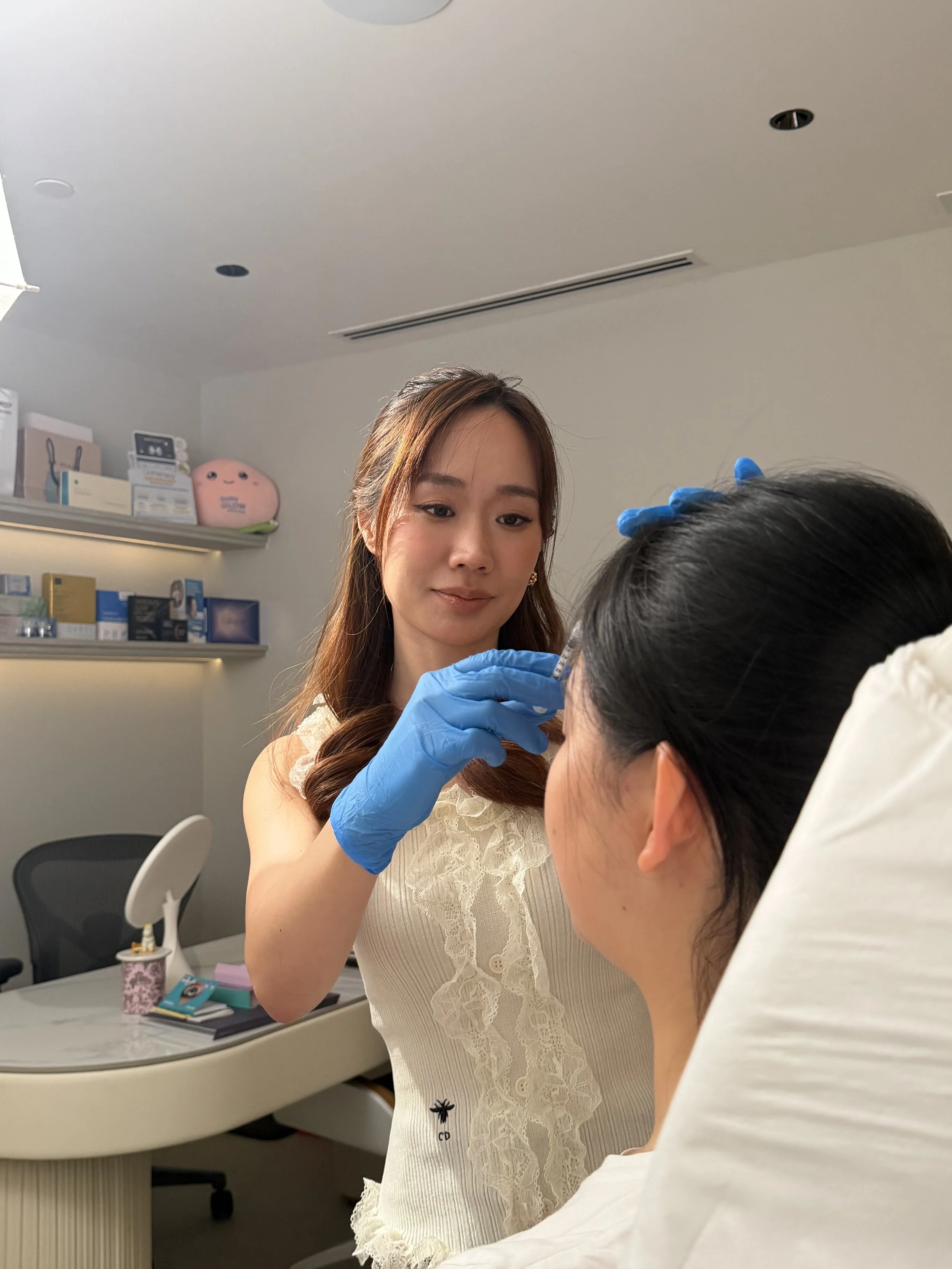
Frequently Asked Questions about Botulinum Toxin
-
It does not have to. A natural result depends on careful muscle assessment, conservative dosing where appropriate and deciding in advance how much movement you want to retain. Some patients prefer stronger line reduction; others prioritise expression. Your plan can be adjusted accordingly.
-
There is no single correct age. Treatment is based on the strength of your facial movement, whether lines remain at rest, and how much they bother you, not on reaching a particular birthday.
-
Facial results often last around three to four months, but duration varies by formulation, dose, treatment area, muscle strength, metabolism and individual response. Large-muscle and sweating treatments may have a different duration.
-
Most facial treatments feel like a series of brief pinpricks. Trapezius, calf, underarm, palm or sole treatments involve more injection points or larger areas, so comfort measures can be discussed during consultation.
-
No. It is intended only for a dynamic muscular jelly roll in carefully selected patients. Eye bags, hollowing, pigmentation, visible vessels and skin laxity require different treatment strategies.
-
No. It is most effective when lower-face width is substantially caused by enlarged masseter muscles. It will not narrow the jaw bone or remove facial fat, and it may be unsuitable if further volume loss would worsen jowling or facial hollowing.
-
It may reduce excessive masseter activity in selected patients, but grinding, jaw pain and headaches can have multiple causes. A dental assessment, night guard or other management may still be required.
-
No. These treatments target muscle activity and contour; they do not reduce body weight or remove fat. A doctor must first confirm that muscle bulk is the main cause of the concern.
-
Commonly assessed areas include the underarms, palms and soles. Selected scalp or facial areas may also be considered. The cause, severity, skin condition and functional risks of each area should be reviewed first.
-
No. SkinTox uses superficial microdroplets of botulinum toxin to influence very fine lines and sweat or oil activity. A skin booster is intended to support hydration or other aspects of skin quality, depending on its composition. They may be complementary but are not substitutes for one another.
-
Often, yes, but the sequence and timing depend on the areas treated and the purpose of each procedure. Dr Jolenda can plan the treatments so that muscle balance, skin quality, facial volume and laxity are addressed in a coordinated way.
-
A review may be recommended to assess symmetry, movement and response once the treatment has had time to settle. Additional treatment is not automatically required; it depends on the original plan and clinical assessment.