
Ultherapy PRIME in Singapore
See My Skin, Lift My Way: Love My PRIME
Personalised non-surgical lifting with real-time visualisation
Ultherapy PRIME in Singapore
What Is Ultherapy PRIME?
Ultherapy PRIME® is an advanced microfocused ultrasound system designed to deliver precisely focused ultrasound energy to specific tissue layers beneath the skin, including the superficial musculoaponeurotic system (SMAS) - a key structural layer that is also targeted during surgical facelift procedures.
What distinguishes Ultherapy PRIME is its use of real-time ultrasound imaging, which allows clinicians to visualise the treatment layers before delivering energy. This helps improve depth selection, treatment precision, and consistency across different facial anatomies.
The focused ultrasound energy creates small, controlled thermal coagulation points within the targeted tissue. This stimulates the skin's natural wound-healing response, promoting neocollagenesis and gradual tissue tightening over the following months.
Common treatment areas include:
Brow lifting
Jawline definition
Under-chin tightening
Neck laxity
Mild to moderate skin laxity of the lower face
Results develop gradually as new collagen forms, with improvements typically becoming noticeable over 2–3 months and continuing to evolve thereafter.
How does Ultherapy PRIME work?
Real-Time Ultrasound Imaging
Ultherapy PRIME uses real-time ultrasound imaging to visualise the skin's deeper tissue layers. This allows your doctor to identify the appropriate treatment depth for each area, helping to improve treatment precision while avoiding non-target surrounding structures.
Micro-focused Ultrasound Energy
Microfocused ultrasound energy is delivered beneath the skin's surface to create precise thermal coagulation points at specific depths, without damaging the outer layer of the skin.
Collagen Remodelling
These controlled thermal coagulation points stimulate the body's natural wound-healing response, triggering neocollagenesis and collagen remodelling over time. As new collagen forms, the treated tissues gradually become firmer and more supportive.
Gradual Natural Lifting
Because collagen regeneration is a gradual biological process, results develop progressively over the following 2–6 months. Improvements appear naturally over time, helping to lift and tighten the skin while maintaining your natural facial expression. The skin gradually becomes firmer and more lifted, producing subtle, natural-looking results without surgery or downtime.
What Is the Emberwood V-Lift Protocol?
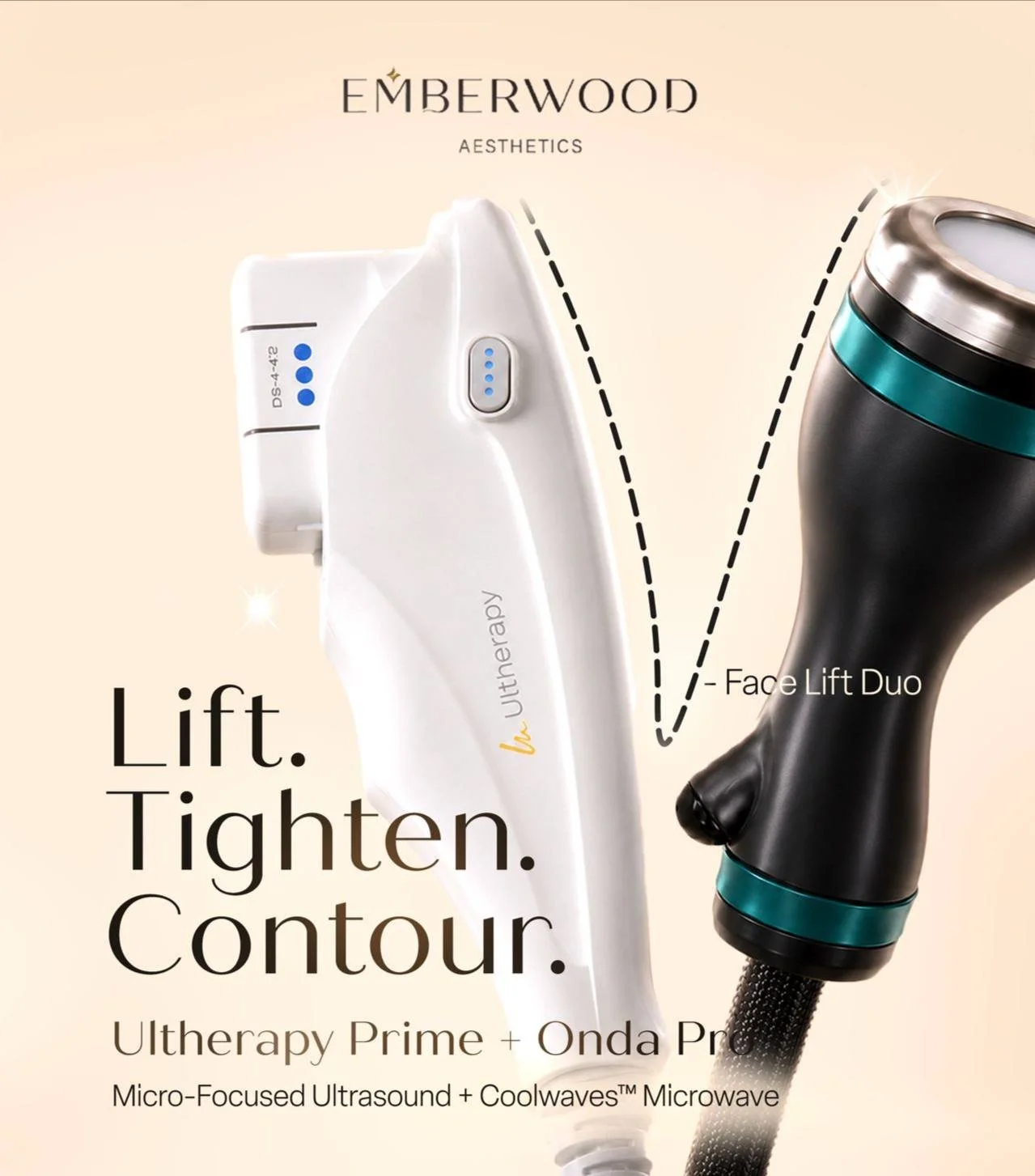
The Emberwood V-Lift Protocol is our doctor-designed approach to non-surgical facial lifting. By combining Ultherapy PRIME, ONDA Pro, and a personalised facial assessment, the protocol addresses multiple contributors to facial ageing to improve skin laxity, restore facial definition, and support natural-looking rejuvenation.

Every face ages differently. Some individuals gradually lose jawline definition, while others develop lower-face heaviness, skin laxity, brow descent, or changes in facial fat distribution. Rather than adopting a one-size-fits-all approach, the Emberwood V-Lift Protocol begins with a comprehensive facial assessment to understand your unique facial anatomy, ageing pattern, and aesthetic goals.

We assess factors such as facial proportions, skin laxity, areas of volume loss, muscle support, and fat distribution before determining where treatment is likely to provide the greatest benefit—and equally importantly, where treatment may not be necessary. This allows us to customise treatment vectors according to your facial structure, helping to achieve balanced lifting while preserving your natural facial expression.

Ultherapy PRIME and ONDA Pro complement one another by targeting different aspects of facial ageing. Ultherapy PRIME delivers microfocused ultrasound to stimulate collagen production and improve skin laxity in deeper structural tissue layers, while ONDA Pro uses microwave technology to selectively target localised fat and support skin tightening in areas of lower-face heaviness. By addressing both tissue laxity and unwanted fat accumulation, the Emberwood V-Lift Protocol provides a personalised strategy for restoring facial definition while maintaining natural-looking results.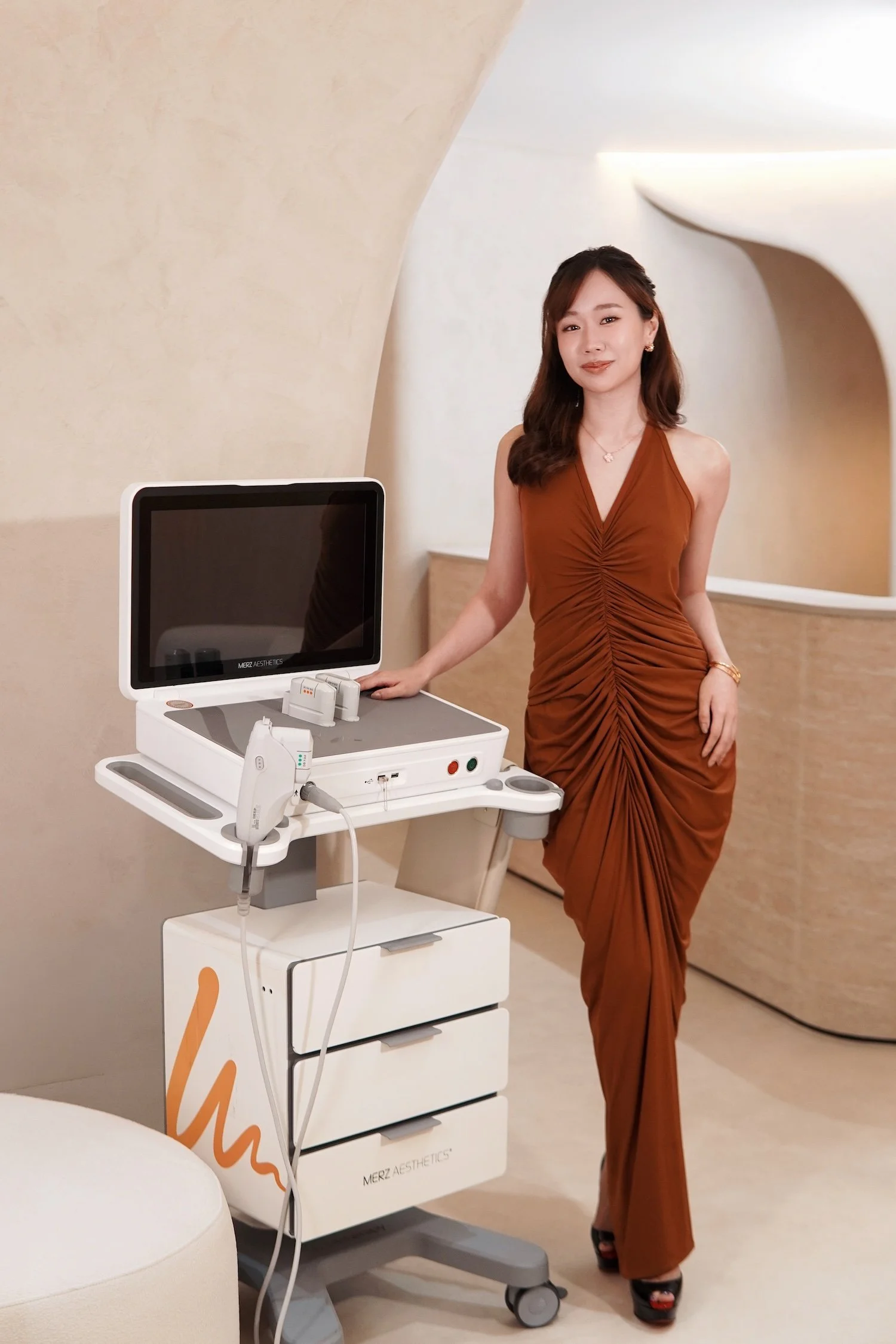
What can Ultherapy PRIME Treat?
-
Ultherapy PRIME helps restore a sharper, more defined jawline by stimulating collagen production along the lower face. It is ideal for patients noticing mild skin laxity or loss of facial definition with age.
-
For patients with a mild double chin caused by loose skin rather than excess fat, Ultherapy PRIME can tighten the area beneath the chin to create a firmer, more sculpted profile.
-
Ultherapy PRIME is an effective non-surgical treatment for loose neck skin, helping improve skin firmness and reduce the appearance of a "turkey neck" over time.
-
Ultherapy PRIME is FDA-cleared to provide a non-invasive brow lift by lifting the skin above the eyebrows, creating a more refreshed, open, and youthful appearance.
-
By stimulating deep collagen production, Ultherapy PRIME helps lift and support the mid-face, improving cheek contours and reducing mild facial sagging.
-
Ultherapy PRIME is best suited for patients with early to moderate skin laxity who want to prevent further sagging and maintain firmer, younger-looking skin without surgery.
-
Ultherapy PRIME enhances natural V-shaped facial contours by tightening loose skin around the cheeks, jawline, and under the chin, resulting in a slimmer, more defined appearance.
Who Is Suitable For Ultherapy PRIME?
Ultherapy PRIME may be considered for individuals with mild to moderate skin laxity who are looking for a non-surgical approach to facial lifting and skin tightening. Following a comprehensive assessment, Dr Jolenda will evaluate your facial anatomy, skin quality and treatment goals to determine whether Ultherapy PRIME is appropriate for you.Patients Seeking a Non-Surgical Facelift
Ultherapy PRIME may be suitable for individuals seeking gradual, natural-looking improvements in skin firmness and facial definition without incisions, injections, or surgery. It is commonly considered by patients who prefer a non-invasive treatment with little to no downtime.Patients with Mild to Moderate Skin Laxity
Ultherapy PRIME is generally most suitable for individuals experiencing early to moderate skin laxity. Patients with more advanced skin sagging may require a different treatment approach, which will be discussed during your consultation.How Can Ultherapy PRIME Support Different Stages of Ageing?
In your 30s: Preventative Ageing
Ultherapy PRIME helps stimulate collagen early to maintain skin firmness and delay the onset of visible sagging.In Your 40s: Early Skin Sagging
Ideal for treating mild to moderate skin laxity, helping lift and tighten the face, jawline, and neck without surgery.In Your 50s: Maintenance & Rejuvenation
Ultherapy PRIME helps restore skin firmness and maintain facial contours, and can be combined with other treatments for enhanced rejuvenation.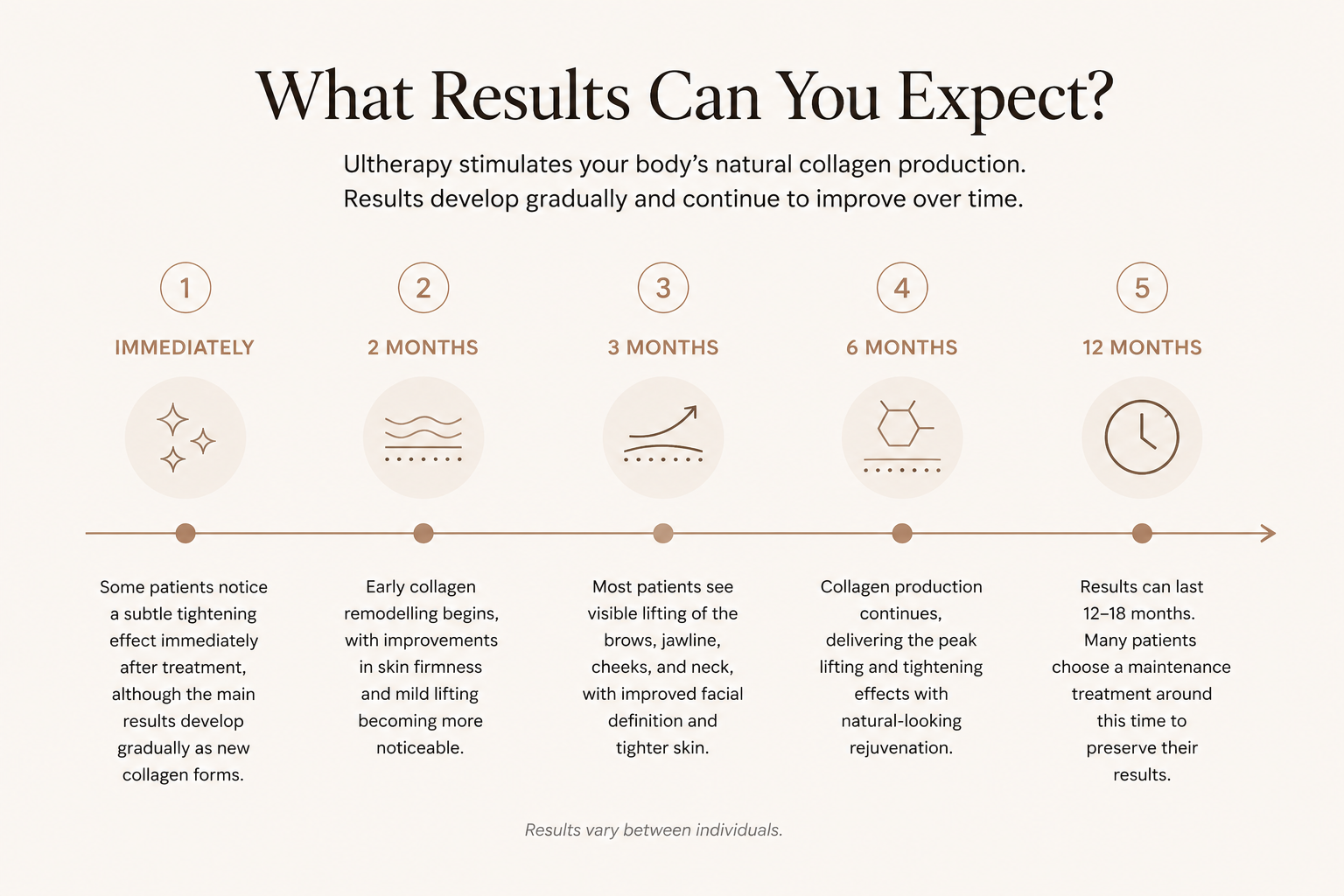
ULTHERAPY PRIME VS HIFU
Understanding Non-Surgical Ultrasound Skin Tightening
As we age, collagen and elastin gradually decline, leading to skin laxity, reduced facial definition, and sagging around areas such as the jawline, cheeks, brows and neck.
Ultrasound-based skin tightening treatments aim to stimulate the body's natural collagen production by delivering focused energy into deeper tissue layers beneath the skin. Two of the most commonly discussed technologies are Ultherapy PRIME® and High-Intensity Focused Ultrasound (HIFU).
Ultherapy PRIME and HIFU are both ultrasound-based technologies designed to stimulate collagen production and improve skin laxity. However, Ultherapy PRIME combines microfocused ultrasound with real-time ultrasound imaging, allowing tissue layers to be visualised. This imaging capability is a key feature that distinguishes Ultherapy PRIME from many conventional HIFU systems. While both technologies use focused ultrasound energy to stimulate collagen production, they differ in their approach to treatment planning, tissue visualisation, and energy delivery.
What is HIFU (High-Intensity Focused Ultrasound)?
High-Intensity Focused Ultrasound (HIFU) uses focused ultrasound energy to create small thermal coagulation points within targeted tissue layers beneath the skin. These controlled thermal injuries stimulate the body's natural wound-healing response, encouraging collagen remodelling over time.
HIFU is often used for:
Mild skin tightening
Early laxity
Jawline and lower face lifting
Non-surgical “facelift” effects
However, many conventional HIFU systems generally do not include real-time imaging, meaning energy delivery is based on preset depth cartridges rather than direct visualisation of tissue layers. As a result, while HIFU can be effective, outcomes may vary depending on device quality, operator technique, and patient anatomy.
Key Differences between Ultherapy PRIME & HIFU
Why choose Ultherapy PRIME?
Both Ultherapy PRIME and HIFU are designed to stimulate collagen using focused ultrasound energy. However, Ultherapy PRIME incorporates several features that distinguish it from many conventional HIFU systems.
Real-Time Ultrasound Imaging guidance
Ultherapy PRIME uses real-time ultrasound imaging to visualise tissue layers before during treatment. This allows your doctor to identify the appropriate treatment depth based on your individual anatomy, whereas many HIFU systems rely on preset treatment depths without imaging guidance.
Energy precision
Ultherapy Prime delivers more controlled, microfocused energy placement, which may improve consistency in collagen stimulation.
Personalised Depth Selection
Although both technologies are capable of targeting deeper tissue layers associated with skin tightening, the addition of real-time imaging allows Ultherapy PRIME to tailor treatment depth according to each patient's facial anatomy, allowing for more tailored energy placement based on individual anatomy.
Treatment Predictability
Because tissue layers can be visualised before treatment, imaging-guided systems such as Ultherapy PRIME may reduce variability in treatment depth selection. This supports a more personalised treatment approach and may contribute to more consistent treatment planning.
Which Treatment is Right for You?
Both Ultherapy PRIME and HIFU are non-surgical ultrasound-based treatments that aim to improve skin laxity through collagen stimulation. The most appropriate treatment depends on factors such as your facial anatomy, degree of skin laxity, treatment goals and the technology available.
At Emberwood Aesthetics, Dr Jolenda performs a personalised facial assessment before recommending treatment. For patients seeking imaging-guided treatment planning with real-time tissue visualisation, Ultherapy PRIME offers additional capabilities that support a tailored approach to non-surgical facial lifting.

Can Ultherapy Prime Be Combined With Other Treatments?
Yes. In modern aesthetic practice, Ultherapy PRIME is often combined with other treatments to address the multiple factors that contribute to facial ageing. While Ultherapy PRIME stimulates collagen production and improves skin laxity, other treatments may be recommended to optimise skin quality, restore facial volume, or address localised fat accumulation where appropriate.
At Emberwood Aesthetics, this personalised approach forms the foundation of our Emberwood V-Lift Protocol, which uses a combination of Ultherapy PRIME and ONDO Pro to a complementary effect. Rather than relying on a single technology, the protocol combines complementary treatments based on your facial anatomy, degree of skin laxity, fat distribution, and long-term ageing patterns to achieve balanced, natural-looking rejuvenation.
Depending on your clinical assessment, Ultherapy PRIME may be combined with:
ONDA Pro
Collagen biostimulators (such as CaHA and PDLLA)
Skin boosters
Laser resurfacing
Dermal fillers
By addressing multiple aspects of facial ageing simultaneously, this layered treatment approach may achieve more balanced and natural-looking outcomes than any single treatment alone.
Every treatment plan is personalised. Following a comprehensive facial assessment, Dr Jolenda recommends treatments based on your individual anatomy, aesthetic goals, and long-term facial ageing pattern.
Authentic Ultherapy PRIME® at Emberwood Aesthetics
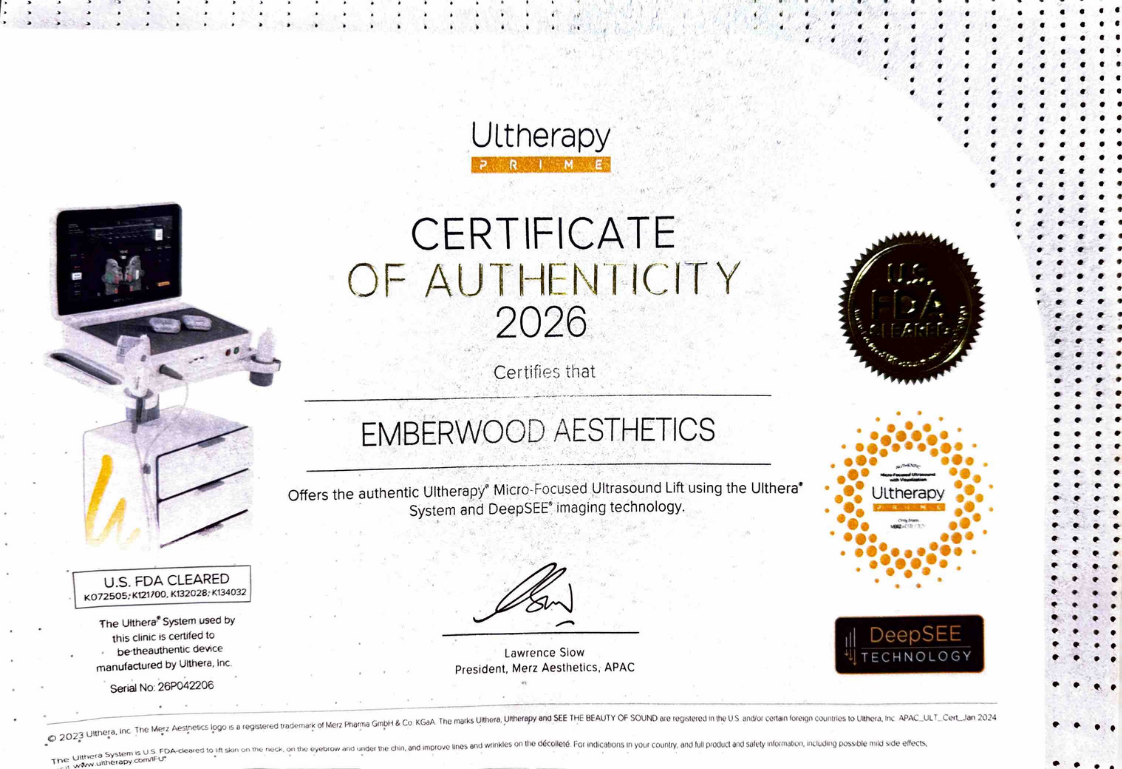
Emberwood Aesthetics offers authentic Ultherapy® Micro-Focused Ultrasound Lift using the Ulthera® System with DeepSEE® imaging technology. Our clinic holds a Certificate of Authenticity, which identifies the individual system used at Emberwood Aesthetics by its serial number and confirms that it is an authentic device manufactured by Ulthera, Inc.
For patients considering Ultherapy, this provides added assurance that the treatment is performed using the genuine Ultherapy technology and system.
Treatment Using an Authentic Ulthera® System
Your Ultherapy treatment is performed using an authentic Ulthera® System certified for use at Emberwood Aesthetics, rather than another ultrasound or HIFU device within the broader category of ultrasound-based aesthetic treatments.
US FDA-Cleared Ulthera® System
The Ulthera® System is US FDA-cleared, providing patients with additional reassurance about the technology used for their treatment.
DeepSEE® Real-Time Imaging
Ultherapy incorporates DeepSEE® imaging technology, allowing the doctor to visualise tissue beneath the skin during treatment and plan ultrasound delivery at the intended treatment depth.
Our Certificate of Authenticity
Our Certificate of Authenticity provides patients with a straightforward way to verify the Ultherapy system used at Emberwood Aesthetics.
When choosing an Ultherapy treatment, knowing which system is being used matters. At Emberwood Aesthetics, you can have the reassurance of treatment using an authentic Ulthera® System with DeepSEE® imaging technology, supported by our clinic's Certificate of Authenticity.
Frequently Asked Questions
-
Ultherapy PRIME is a non-invasive skin lifting treatment that uses microfocused ultrasound energy to stimulate collagen production and tighten the skin.
-
Most patients experience mild discomfort during treatment, but it is generally well tolerated. At Emberwood, we use our Emberwood Pain Protocol, which may include oral pain relief, topical numbing cream, and cooling measures to maximise comfort throughout the procedure.
-
Results typically last 12–18 months, depending on your age, skin condition, and natural ageing process.
-
Most patients only require one treatment session, with maintenance treatments recommended every 12–18 months.
-
Ultherapy PRIME uses real-time ultrasound imaging to precisely target the treatment area, offering greater accuracy than most HIFU devices.
-
There is little to no downtime. Most patients return to their normal activities immediately after treatment, although some may experience mild swelling, tenderness, or an achy sensation for a few days.
-
No. Ultherapy PRIME is best for mild to moderate skin laxity and cannot achieve the same degree of lifting as a surgical facelift.
-
Ultherapy PRIME is not recommended for patients with severe skin laxity, active skin infections in the treatment area, or certain implanted medical devices. A consultation is needed to determine suitability.
Contact Us
Your journey toward refined beauty starts with a conversation.
Share your aspirations with us, and our specialists will reach out to curate your personal consultation